Independent product
AmarBebsa
An independently built, AI-powered multi-tenant e-commerce SaaS connecting merchant storefronts, commerce operations, and multilingual customer assistance.
Visit live productThe commerce, tenant, subscription, and AI capabilities described here are implemented in the product source and reflected in its public presentation. Meta messaging and comment integrations are implemented; availability for external merchants depends on Meta Business Verification, App Review, and provider permissions. This case study does not claim those approvals are complete.
01 Project overview
A merchant needs more than a storefront: products and stock, customer questions, orders, delivery, staff access, and subscription management all need to work together. AmarBebsa brings these workflows into one platform while giving each business its own branded storefront and administration workspace. I created the product and built its application layers, integration boundaries, and deployment workflow.
My role
Creator & Full-Stack Engineer. I independently own the product and work across architecture, Next.js storefront and public applications, React merchant administration, Node.js APIs, MongoDB and Redis, AI and commerce integrations, and Docker-based cloud deployment. The source code is private.
02 Problems solved
- Merchants need an independent storefront and operational workspace without managing a separate software installation for every business.
- Catalog, stock, orders, customers, and delivery information must stay consistent across storefront, administration, and integrations.
- Customers ask questions in Bangla, English, and Banglish, and often send a product picture instead of a product name.
- AI assistance needs access to real product data without being allowed to invent prices, cross merchant boundaries, or place an order without customer confirmation.
- Subscription changes and usage limits must control feature access while preserving merchant data.
03 Technical implementation
Tenant-aware commerce
Built independent merchant storefronts and administration backed by tenant-scoped product, inventory, order, customer, and configuration workflows. Merchant context is resolved at the application boundary and carried through API and data access so one business cannot act on another business's records.
Catalog-grounded AI assistance
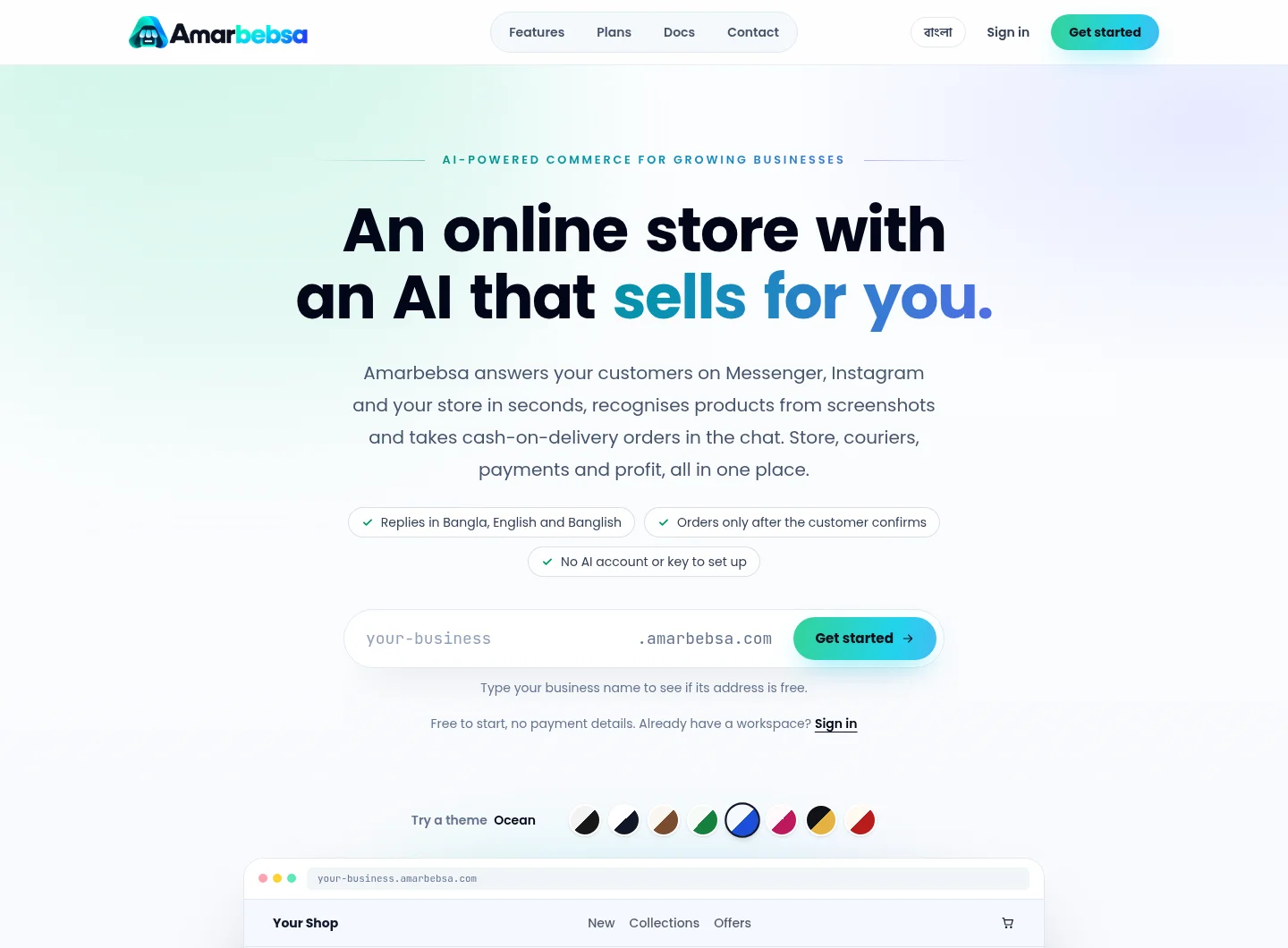
Integrated LLM providers, including Gemini, behind an application service. Product tools retrieve current catalog information, prices, and stock. The assistant supports Bangla, English, and Banglish interactions, product discovery, and a customer-confirmed cash-on-delivery order journey.
Product image understanding
Implemented image analysis and catalog matching so customer-provided product pictures can participate in discovery. Image analysis is metered through the subscription allowance system alongside AI replies.
Merchant operations & integrations
Connected product and variant management, inventory, customer and order records, courier workflows, and payment integration boundaries. Courier adapters support Steadfast, Pathao, and RedX; SSLCommerz supports online checkout when configured by the merchant.
Subscriptions, access & ownership
Implemented subscription lifecycle and feature entitlements, monthly allowances, authentication, and role-based permissions. Staff access and feature usage are evaluated within the merchant context, with product and order data retained when a plan changes.
Deployment & delivery
Built Docker-based application delivery with Nginx ingress, Linux and AWS deployment configuration, and GitHub Actions. The public application, storefront, merchant administration, platform administration, and API have distinct responsibilities within the product.
04 Technologies used
05 Challenges & solutions
Challenge 01
Keeping every merchant's commerce data isolated while sharing application services.
Solution
Propagated explicit business context through application and data-access layers, and scoped staff authorization, records, configuration, and integration credentials to that context.
Challenge 02
Making AI useful for commerce without giving a language model authority over prices or unconfirmed purchases.
Solution
Kept prices and stock in catalog tools. Order state and summaries are application-controlled, customer confirmation gates submission, and the assistant does not initiate payments, refunds, or courier bookings.
Challenge 03
Coordinating automation with human support and external messaging constraints.
Solution
Implemented human handoff, duplicate-event protection, and provider-aware reply boundaries. Meta integrations have explicit provider approval requirements before wider merchant access.
Challenge 04
Applying subscription limits consistently across AI replies, image analysis, and commerce actions.
Solution
Centralized entitlement and allowance checks, separating feature access from monthly usage and retaining merchant records through subscription changes.
06 Product in focus
07 Architecture & technical details
The platform separates public acquisition and account flows, merchant storefronts, merchant administration, platform operations, and a shared tenant-aware API. Commerce rules, permissions, subscription entitlements, and integration services stay behind that API.
Public & customer applications
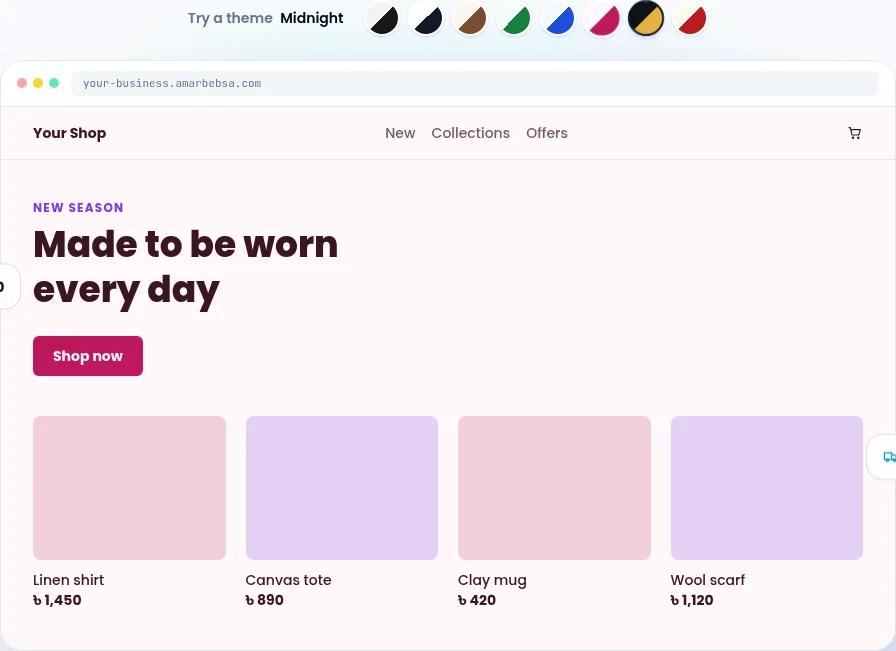
Next.js handles product discovery, account entry, and merchant-specific storefronts with configurable branding and customer shopping journeys.
Merchant & platform administration
React merchant administration manages commerce workflows; a separate platform application handles operator responsibilities and subscription administration.
Tenant-aware API & persistence
Express services coordinate authorization, commerce, and subscription logic over MongoDB, with Redis supporting shared application services.
AI & commerce adapters
Provider adapters connect LLMs, image analysis, messaging, couriers, and payments through explicit boundaries. Model-facing tools use the active merchant's catalog and application rules.
Cloud delivery
Docker, Nginx, Linux, AWS, and GitHub Actions support application deployment without exposing operational credentials or merchant information.